
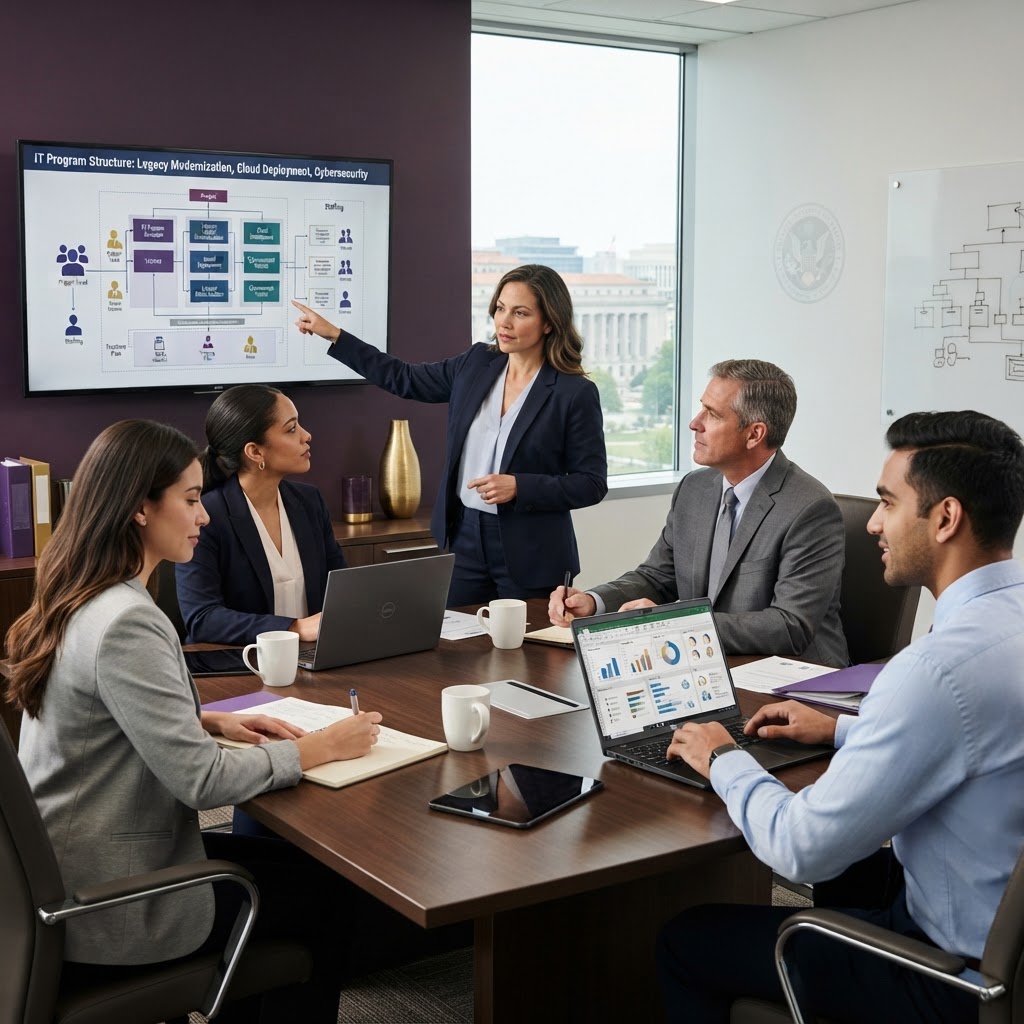
Federal and state agencies invest heavily in technology acquisitions — cloud migrations, ERP modernizations, cybersecurity platforms, data analytics environments — yet workforce planning is frequently scoped too narrowly or too late. The result is a familiar pattern: systems go live, adoption stalls, and program offices scramble to backfill skills gaps that were visible months earlier.
Effective workforce development planning for technology-intensive programs is not an HR function bolted onto a technical project. It is a program management discipline that runs parallel to architecture, procurement, and implementation from day one.
Why Skills Gaps Emerge Even on Well-Funded Programs
Agencies often inherit workforce conditions shaped by years of contractor dependency, hiring freezes, and legacy system specialization. When a program introduces a new technology stack — say, migrating from an on-premises Oracle environment to a cloud-based ERP like Microsoft Dynamics 365 or SAP S/4HANA — existing staff may have deep institutional knowledge but limited experience with the incoming platform's configuration, data model, or integration patterns.
Three common failure points:
- Role definition lags behind system design. Program teams finalize technical architectures before anyone has mapped out what roles will operate and maintain the system post-deployment. System administrators, data stewards, security operations staff, and business analysts all need defined responsibilities before go-live, not after.
- Training is treated as a one-time event. A two-week pre-launch training block is insufficient for systems that require sustained operational expertise. Cloud platforms in particular require ongoing learning as services evolve.
- Contractor knowledge transfer is unstructured. Many agencies rely on implementation contractors to build and configure systems with the assumption that knowledge will transfer to government staff organically. Without explicit knowledge transfer plans, deliverables, and competency checkpoints written into contracts, this rarely happens effectively.
A Practical Planning Framework
Workforce development planning for a technology program should address four sequential questions:
1. What roles does this system require at steady state? Start from the operational end state. A cloud-hosted system running on AWS GovCloud or Azure Government needs cloud infrastructure administrators, IAM governance owners, security monitoring staff, and application owners — in addition to functional users. Map these roles explicitly before procurement or design is complete.
2. What is the current workforce baseline? Conduct an honest skills inventory. This means assessing not just whether staff hold relevant certifications, but whether they have applied those skills in a comparable operational context. A staff member who holds a CompTIA Security+ but has never worked in a SOC environment is not the same as one who has. Identify gaps by role, not just by headcount.
3. What is the right mix of hiring, training, and contracted support? Few agencies can close all gaps through internal training alone, nor should they depend entirely on contractors for operational functions. A realistic plan identifies which capabilities must be government-owned (typically those touching sensitive data governance, security operations, and program oversight), which can be supported by contractors long-term, and which represent transitional needs during implementation.
4. How is competency validated over time? Workforce readiness is not binary. Build assessment checkpoints into the program schedule — not just at go-live, but at six and twelve months post-deployment. For cybersecurity programs specifically, tabletop exercises and functional drills provide more actionable readiness data than training completion rates.
Considerations for Cybersecurity and OT Environments
Programs that involve operational technology, industrial control systems, or supply chain risk management introduce additional complexity. Staff coming from traditional IT backgrounds may be unfamiliar with OT-specific threat models, network segmentation constraints, or the safety implications of system availability in ways that don't apply to enterprise IT environments.
For these programs, workforce development should include scenario-based exercises grounded in the specific environment — not generic awareness training. A team responsible for supply chain risk management under NIST SP 800-161 needs to understand vendor assessment workflows, component provenance tracking, and incident escalation paths in their actual program context.
Connecting Workforce Planning to Acquisition Strategy
One of the most direct levers program offices have is the contract vehicle itself. Performance work statements and task order requirements should include explicit knowledge transfer obligations, documentation standards, and transition criteria. Agencies that treat these as boilerplate often find themselves unable to operate systems independently when contract periods end.
Position descriptions for government staff should be developed in parallel with system design — not after procurement closes. Classification and hiring timelines in the federal space are long, and waiting until a system is six months from deployment to initiate hiring actions virtually guarantees a staffing gap at go-live.
The Underlying Principle
Technology programs succeed or fail based on the people running them. The most well-architected cloud environment, the most carefully configured ERP, and the most compliant security platform will underperform if the workforce is not prepared to operate it with competence and ownership. Treating workforce development as a parallel program workstream — with the same rigor applied to technical design — is not an aspirational practice. It is a basic condition of program success.