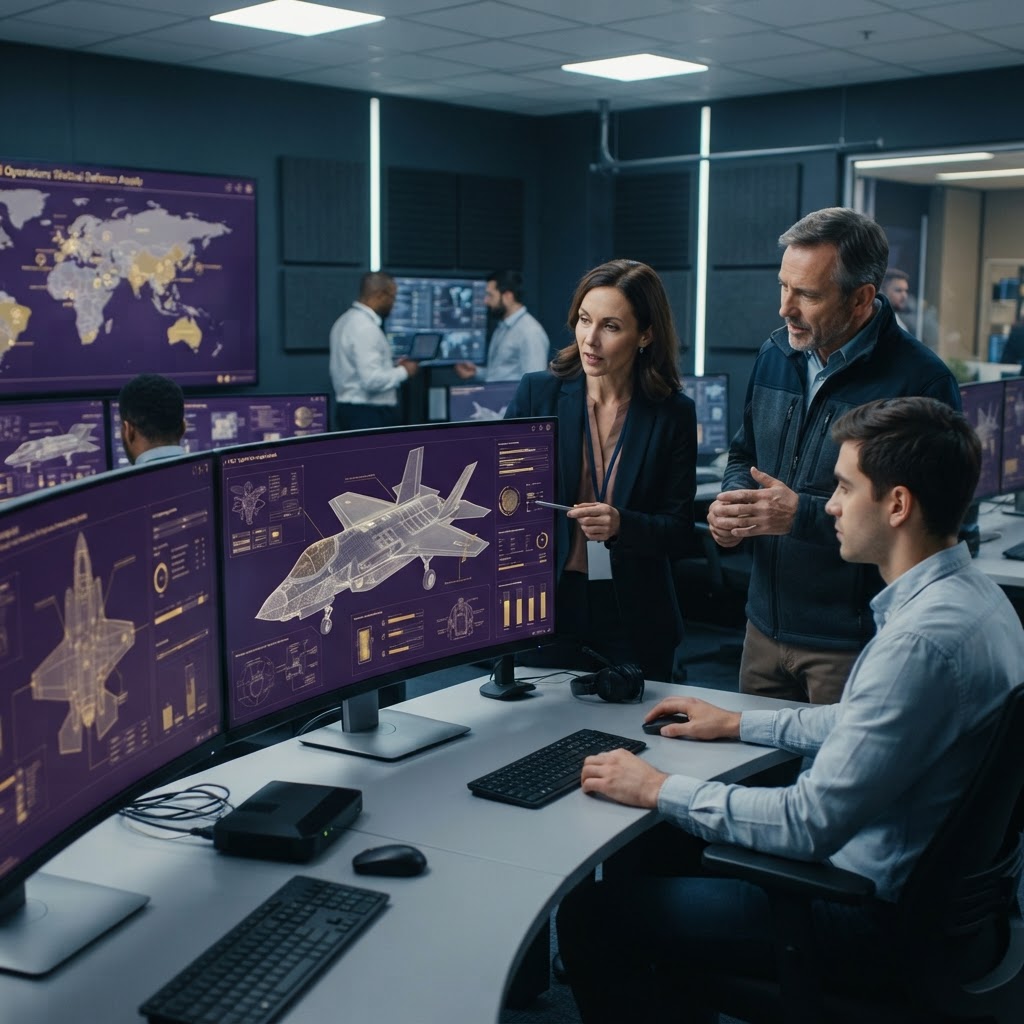
The U.S. Department of Defense spends roughly 70 cents of every acquisition dollar on operations and support — the long tail of system ownership that stretches decades beyond initial fielding. For platforms like the F-35, DDG-51 destroyers, or ground vehicle fleets, the cost and complexity of sustainment dwarfs the original development investment. Digital twins are increasingly central to how defense programs are attempting to change that math.
What a Digital Twin Actually Is — and Isn't
A digital twin is a continuously updated virtual model of a physical system, synchronized with real-world sensor data and operational history. This distinguishes it from a simulation or a CAD model, both of which are static by nature. A true digital twin reflects the current state of a specific asset — not a generic model of its type.
For a naval vessel, that means the twin incorporates hull stress data, engine hours, corrosion sensor readings, and maintenance records. For an aircraft, it reflects actual flight load cycles on specific structural components, not fleet averages. That specificity is what makes the technology useful for predictive maintenance, failure analysis, and configuration management.
Where Digital Twins Are Being Applied Today
Several defense programs have moved beyond proof-of-concept into operational use:
- Air Force Research Laboratory and sustainment modeling: AFRL has invested in digital thread and digital twin capabilities to track structural fatigue on aging aircraft, reducing reliance on scheduled depot inspections driven by calendar time rather than actual wear.
- Navy shipbuilding and lifecycle management: The Navy's Product Lifecycle Management Plus (PLM+) initiative integrates digital twin concepts into ship design and maintenance planning, particularly for Virginia-class submarines.
- Army Next Generation Combat Vehicle (NGCV): Program offices are building digital engineering environments that include twin models intended to persist from design through fielded sustainment.
- Defense Advanced Research Projects Agency (DARPA): The Automated Rapid Certification of Software (ARCOS) and related programs are exploring how verified digital models can accelerate system certification.
These aren't speculative future programs. They are active, funded efforts with contracting vehicles and integration requirements that vendors and system integrators are navigating right now.
The Systems Engineering Foundation Matters
Digital twins don't deliver value in isolation. They depend on a coherent digital thread — a connected data architecture that links requirements, design models, test data, and operational telemetry across the system lifecycle. Without that underlying structure, a digital twin is just a visualization tool.
This is where many programs encounter friction. Legacy defense systems were built without data continuity in mind. Technical data packages exist in disparate formats across contractors, depots, and program offices. Integrating those sources into a unified twin requires deliberate data governance work, not just software deployment.
Key architectural considerations include:
- Data provenance and configuration control: The twin must reflect verified configuration states, not assumed ones. This requires integration with authoritative configuration management databases.
- Sensor data pipelines: Real-time synchronization depends on reliable telemetry infrastructure, which for deployed military systems often means working within constrained and intermittent connectivity environments.
- Model fidelity calibration: Higher fidelity isn't always better. The resolution of the model should match the decision it's supporting — a readiness forecast needs different granularity than a stress fracture analysis.
- Security architecture: Digital twins aggregate sensitive operational and technical data. Access controls, data classification handling, and supply chain considerations for twin platform components require careful design, particularly under frameworks like CMMC and RMF.
Realistic Expectations for Lifecycle ROI
The strongest near-term return on investment comes from two areas: predictive maintenance and test and evaluation acceleration.
In predictive maintenance, twins enable condition-based maintenance approaches that reduce unnecessary scheduled downtime. When a component is replaced based on actual wear data rather than a fixed interval, programs recover availability and reduce parts consumption. The F-35 program's Autonomic Logistics Information System (ALIS), and its successor ODIN, reflect this approach despite well-documented implementation challenges that illustrate the difficulty of execution.
In test and evaluation, virtual testing using calibrated twins can reduce the number of physical test events required for design changes or modification kits. This matters enormously for programs operating under constrained test ranges and tight modification timelines.
What digital twins do not reliably deliver — at least not yet — is the kind of fully autonomous, self-healing system management that marketing materials sometimes suggest. Human judgment remains essential for interpreting twin outputs, authorizing maintenance actions, and managing the gap between model predictions and real-world behavior.
Where Programs Should Focus Next
For program managers and systems engineers working through digital engineering adoption, the priority should be on building the data infrastructure before the twin model. That means investing in:
- Authoritative data sources and configuration management discipline
- Open architecture standards (such as the DoD's Digital Engineering Strategy guidance) that prevent vendor lock-in
- Workforce capability to interpret and act on twin outputs, not just maintain the platform
Digital twins represent a mature enough concept that the question is no longer whether to pursue them, but how to build the foundational systems engineering discipline that makes them work in practice.