
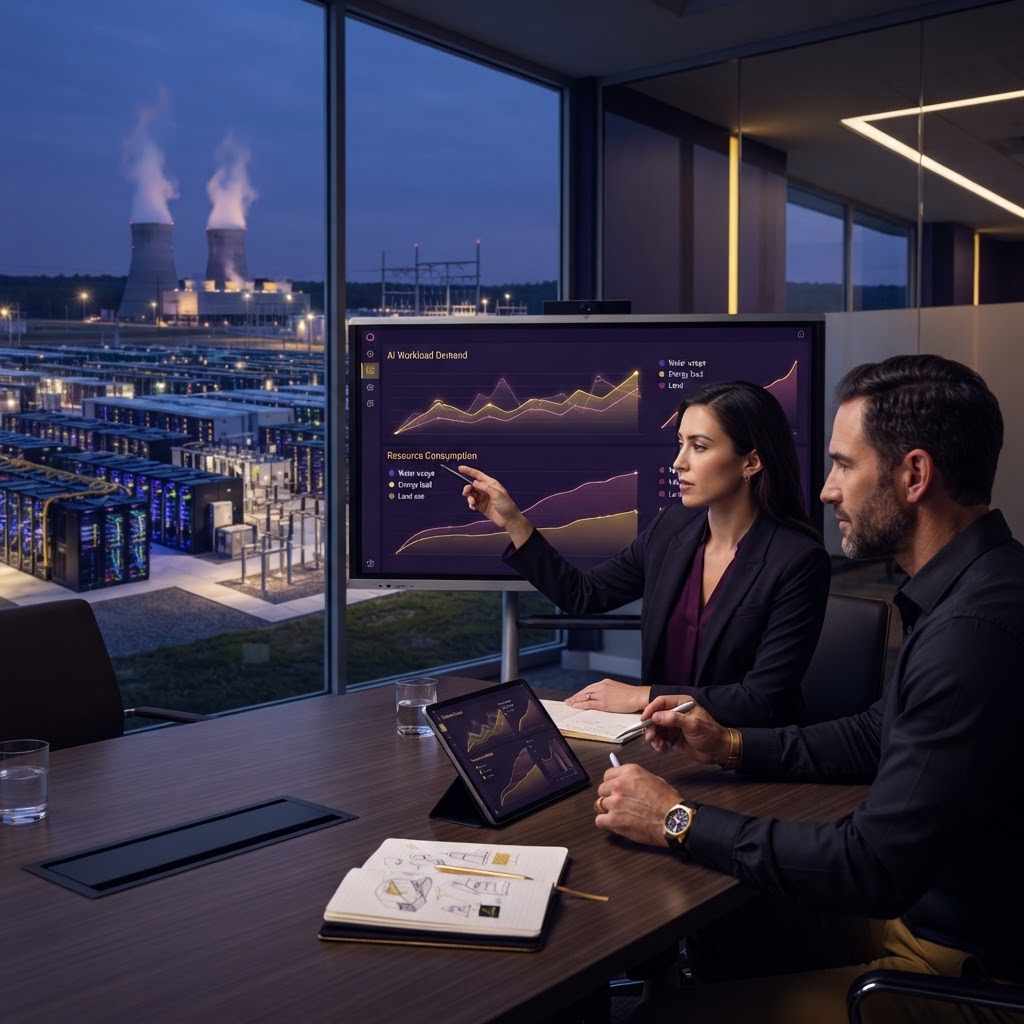
A single query to a large language model consumes roughly ten times the energy of a standard Google search. Multiply that across millions of daily interactions, and you begin to understand why power grids from Virginia to Arizona are under strain. The infrastructure supporting AI is not abstract — it is physical, it is resource-intensive, and it carries real costs that belong in every serious IT strategy conversation.
Water Consumption: The Overlooked Variable
Most attention goes to electricity, but water is equally significant. Large-scale data centers use evaporative cooling systems that can consume millions of gallons of water daily. Microsoft's data centers consumed approximately 1.7 billion gallons of water in 2022, a figure that increased sharply in 2023 as AI workloads expanded. Google and Amazon report similar trends.
For federal agencies operating in water-stressed regions — or evaluating cloud contracts with providers in those regions — water usage effectiveness (WUE) metrics should be part of due diligence. This is not a theoretical concern. Data center development has already faced local opposition in Arizona and the Netherlands specifically over water rights and aquifer impact.
Energy: Capacity, Not Just Consumption
The energy conversation needs to move beyond carbon commitments and focus on grid capacity. Northern Virginia, home to the highest concentration of data centers in the world, is experiencing real transmission constraints. Dominion Energy has reported multi-year queues for new large-load connections. Some hyperscale providers are now securing dedicated power purchase agreements with nuclear facilities — Microsoft's deal with Constellation Energy to restart a unit at Three Mile Island is the clearest recent example.
For government and enterprise IT planners, this creates several concrete considerations:
- Colocation contracts signed today may not guarantee the power density needed for GPU-intensive AI workloads in two to three years
- Cloud regions are not infinitely expandable — availability zone capacity is physically constrained by local grid infrastructure
- On-premises AI inference hardware, such as NVIDIA's newer rack-scale systems, shifts energy burden back to agency facilities that may not be engineered for those loads
Land Use and Facility Siting
Building a hyperscale AI-capable data center requires 100 to 500 acres depending on configuration, cooling approach, and redundancy design. That land competition is becoming a real constraint in established markets. Providers are moving into secondary markets — Columbus, Ohio; Denton, Texas; Boise, Idaho — partly because of land availability and partly because of proximity to cheaper renewable energy sources.
Federal agencies with on-premises or hybrid infrastructure requirements should factor facility engineering into AI roadmaps. A building designed for traditional server racks in 2010 is unlikely to support the power density and cooling requirements of modern AI accelerators without significant capital investment.
What Responsible Planning Looks Like
None of this argues against AI adoption. It argues for honest accounting. Several concrete steps are worth embedding into planning processes now:
- Request WUE and PUE disclosures from cloud providers as part of contract negotiations, not just sustainability reports. Specific facility-level data is more useful than corporate averages.
- Evaluate workload placement against infrastructure realities. Training large models in a constrained-grid region has different cost and risk profiles than running inference workloads closer to end users.
- Assess facility readiness before hardware procurement. Before acquiring on-premises AI inference appliances, conduct a power and cooling audit. Many federal facilities will require infrastructure upgrades that add 12 to 18 months and significant cost to deployment timelines.
- Build resource consumption into total cost of ownership models. Energy and water costs are variable and rising. A five-year TCO model that treats these as fixed assumptions will produce inaccurate projections.
- Monitor emerging regulatory requirements. The EU is already moving toward mandatory data center environmental reporting. U.S. federal procurement policy is likely to follow, particularly under sustainability executive orders that remain in effect.
The Near-Term Trajectory
The Department of Energy projects that data centers could account for up to 12 percent of U.S. electricity consumption by 2028, up from roughly 4 percent today. That projection is not alarmist — it is based on announced capacity expansions from AWS, Microsoft, Google, and Meta, combined with expected AI workload growth.
Liquid cooling, small modular reactors, and more efficient AI chip architectures — such as those in development at Cerebras and Groq — will help at the margin. But they will not resolve the fundamental tension between rapidly scaling AI infrastructure and finite natural resource availability in the near term.
For senior leaders making infrastructure and cloud investment decisions today, the honest framing is this: AI capability comes with a physical footprint, and that footprint has costs and constraints that belong in the same conversation as performance benchmarks and licensing fees.